



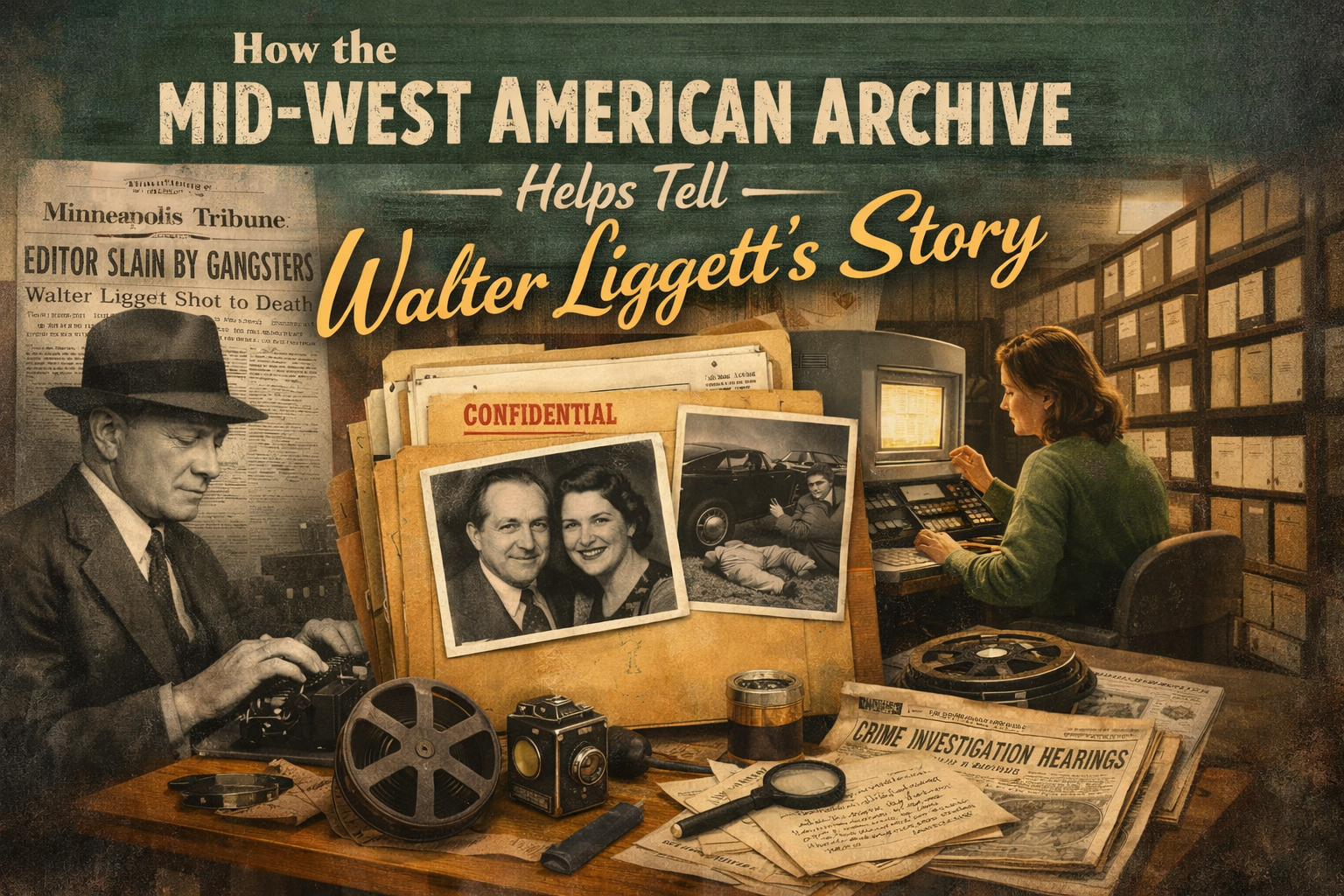
The story of Walter Liggett is bigger than one murder case, one newspaper, or one moment in Minnesota politics. What makes it so compelling today is the paper trail he left behind and the way that trail still speaks. When people search for the Mid-West American archive, they are usually not just looking for an old newspaper title. They are trying to understand how a small weekly paper, a combative editor, and a violent political era came together in one of the most unsettling journalism stories in Minneapolis history.
That is where the archive matters. The Liggett Family Papers at NYU Special Collections do not simply preserve a name. The collection gathers research files, newspaper clippings, interviews, family papers, and photographs tied to Walter William Liggett, his assassination, and the later work of his daughter Marda Liggett Woodbury, who spent years reconstructing what happened to her father. In practical terms, that means the archive helps readers move past myth and into documented history.
Why Walter Liggett still stands out
Before he became the editor most people now remember, Walter Liggett had already built a serious career in journalism. The NYU finding aid notes that he worked for several newspapers in New York City, including the New York Times, the Sun, the New York Post, the Daily News, and the Socialist paper The Call. He had also worked earlier in Minnesota at the Pioneer Press, Minneapolis Journal, and St. Paul Dispatch. That background matters because it shows he was not a fringe figure who stumbled into controversy. He was an experienced journalist who returned home with strong political convictions and a willingness to use print as a weapon.
When he returned to Minnesota in 1932, he threw himself into the political world around the Farmer-Labor Party and the newspaper known as the Mid-West American. At first glance, that might sound like the story of a party loyalist. It was not. Over time, Liggett moved from supporter to fierce critic, using the paper to attack what he believed was growing corruption inside the political machine surrounding Governor Floyd B. Olson. That shift is central to understanding both his legacy and the danger he placed himself in.
What the Mid-West American represented
It is easy to underestimate a small weekly newspaper when reading about it decades later. But the Mid-West American mattered because it was direct, local, and relentless. TIME described Liggett’s paper as a weekly tabloid that regularly denounced the alliance between the underworld and Minneapolis and Minnesota officialdom. The book overview for Stopping the Presses says the paper sought to expose machine politics and corruption in Minnesota. Those descriptions help explain why the paper still matters in archive form. It was not just another publication from the 1930s. It was a running argument with power.
That is also why the archive is so valuable. A paper like the Mid-West American was built for the urgency of the moment. Weekly attacks, local names, accusations, and political feuds can disappear quickly once the headlines move on. Archival material gives that urgency a second life. It lets modern readers see that Liggett’s work was not abstract talk about reform. It was specific, adversarial reporting aimed at real people with real influence.
The archive gives the story shape
One of the most useful things about the Liggett Family Papers is that they preserve more than one kind of evidence. The collection includes newspaper clippings, research files, interviews, family papers, and photographs. That mix matters because stories like this often break apart when only one source survives. Newspaper coverage can be sensational. Family memory can be personal and emotional. Later historical writing can smooth over contradictions. An archive that holds all of those layers together gives readers a fuller and more honest view.
This is especially important in Liggett’s case because his story has always lived at the intersection of journalism, politics, and organized crime. On one side, there was his role as a reform-minded editor. On the other, there was the violent world he was reporting on and the political names he was willing to print. The archive helps bridge those worlds by preserving both the public controversy and the private aftermath. It shows not only what he published, but also how his family and later researchers tried to make sense of the consequences.
The murder that changed everything
On December 9, 1935, Walter Liggett was shot in Minneapolis after years of conflict with powerful people and institutions. The NYU finding aid says he was gunned down in front of his wife and daughter after exposing a connection between local organized crime and Governor Floyd B. Olson. TIME reported that he was riddled by machine-gun fire as he got out of his car behind his apartment building, and Minnesota Monthly recounts that the killing happened after he had spent the day working on stories for the next issue of the Midwest American.
That moment is the event most people know, but the archive helps show why it cannot be read as an isolated crime. By preserving research on Liggett’s reporting, his political battles, and the aftermath of the case, the archive places the murder back into its larger context. The killing did not come out of nowhere. It came at the end of a sustained fight over corruption, influence, and the role of the press in exposing both.
Where Kid Cann enters the story
No serious discussion of Walter Liggett can ignore Isadore Blumenfeld, better known as Kid Cann. The published overview of Stopping the Presses says Liggett’s wife identified Kid Cann as the killer and that Cann was indicted by a grand jury but not convicted. Minnesota Monthly likewise notes that Liggett’s family long believed more powerful figures were behind the murder, while Historyapolis records that Edith Liggett was adamant that she recognized Kid Cann and that he ultimately escaped conviction.
That does not mean the archive hands readers a perfectly neat answer. In fact, part of its value is that it preserves uncertainty. Historical cases like this often harden into legend, especially when they involve gangsters, governors, and a dead publisher. The archive slows that process down. It reminds us what was documented, what was believed, what was argued in public, and what remained unresolved. That kind of restraint is part of what makes archive-based storytelling stronger than rumor.
Why Marda Liggett Woodbury matters so much
If the archive tells Walter Liggett’s story, it does so in large part because his daughter refused to let the record stay thin or distorted. The NYU collection description says much of the material relates to Marda Liggett Woodbury’s research on her father’s life and assassination. The University of Minnesota Press overview adds that she spent more than eight years researching the events and believed the historical record was inadequate or simply wrong.
That detail changes how the archive should be read. It is not just a storage box for old scandal. It is also a corrective effort. Marda Liggett Woodbury was not merely preserving family memory. She was building a research-based counterweight to incomplete reporting, sloppy conclusions, and the way powerful stories can get simplified over time. Because of her work, the archive becomes more than background material. It becomes part of the struggle over who gets to define the truth of what happened.
The archive shows the story is about more than murder
What gives the Mid-West American archive real depth is that it does not reduce Liggett to a victim. Yes, the assassination is central. But the preserved materials also point back to his broader life as an author, journalist, and political activist. The collection summary places him inside a bigger network that included the Farmer-Labor Party, the Daily Worker, libel litigation, and the political culture of Minnesota in the 1920s and 1930s. That wider frame matters because it shows that his death was the end of a public career, not the beginning of one.
This is why archive work is so important for journalism history. Headlines tend to flatten people into roles. Crusader. Victim. Radical. Martyr. But collections like this let readers see movement over time. They show careers, alliances, reversals, family involvement, and the messy overlap between ideals and institutions. In Liggett’s case, that makes the story far more interesting than a simple true-crime summary.
What modern readers can still learn from it
There is a reason Walter Liggett’s story still feels current. A small paper accusing political power of colluding with criminal interests does not sound like a relic. It sounds familiar. So does the fear that local corruption can hide in plain sight when too few people are willing to challenge it. The published overview of Stopping the Presses describes Minneapolis in the 1920s and 1930s as a place where gangsters and politicians were partners in illegal enterprises, and it presents Liggett as one of the few journalists willing to keep pressing that point.
The archive does not just preserve those accusations. It preserves the cost of making them. That is what gives the material its lasting force. Readers come away understanding not only what Walter Liggett wrote, but also why a paper like the Mid-West American could become dangerous to produce. The closer journalism gets to local power, the more personal the stakes can become. Liggett’s papers keep that truth from fading into a vague footnote.
Why the Mid-West American archive still matters
In the end, the Mid-West American archive helps tell Walter Liggett’s story because it preserves both the public fight and the private wreckage left behind. It gives readers access to the machinery of memory: the clippings, the interviews, the family papers, the later research, and the biographical framing that hold the story together. It also remains accessible. The NYU finding aid states that the materials are open without restrictions, which matters for anyone trying to study Liggett as more than a headline from 1935.That is the real value here. The archive does not magically solve every mystery around Walter Liggett, Kid Cann, or Floyd B. Olson. What it does do is something just as important. It keeps the record open. It allows a small newspaper, a murdered editor, and a politically explosive chapter of Minnesota history to remain visible, searchable, and arguable. For a figure like Walter Liggett, that may be the most honest form of legacy possible.
