



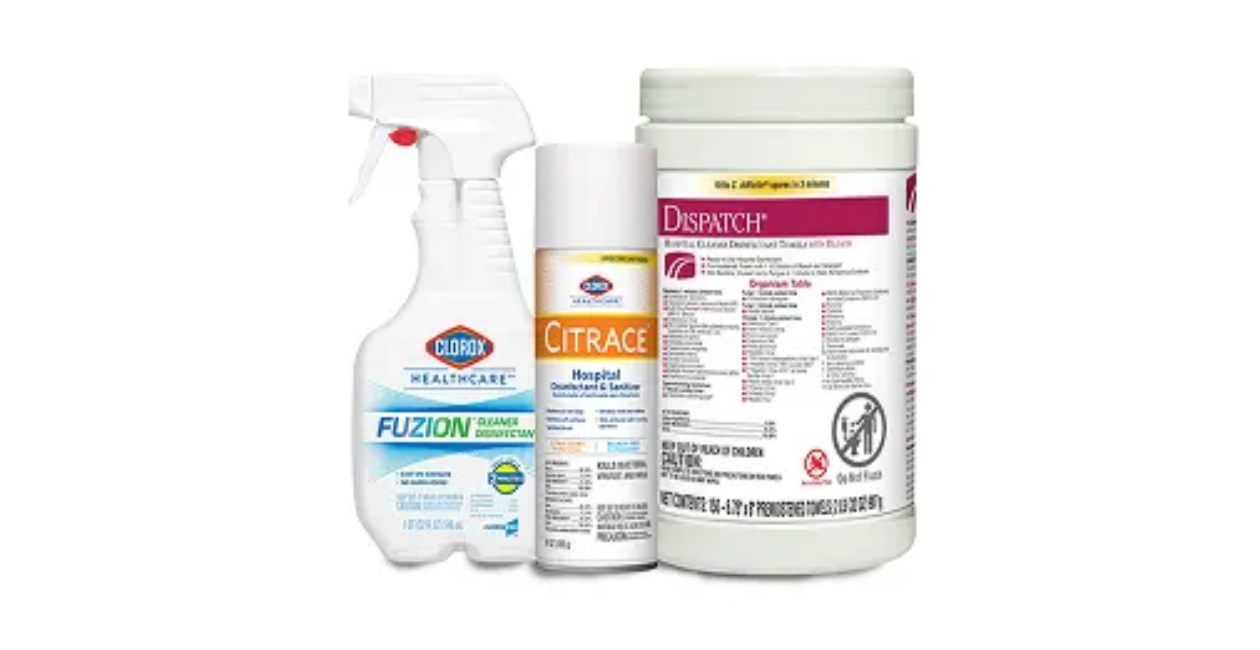
When people compare hospital grade cleaning products, the smartest place to start is not the brand name. It is the active ingredient. That is because disinfectants used in healthcare are not interchangeable. The CDC says healthcare settings use a range of chemistries, including alcohols, chlorine compounds, glutaraldehyde, hydrogen peroxide, iodophors, ortho-phthalaldehyde, peracetic acid, phenolics, and quaternary ammonium compounds, and that each product is designed for a specific purpose and must be used the right way. The EPA also makes the same basic point from a regulatory angle: disinfectant labels matter, and claims against specific pathogens have to be reviewed and approved.
That is why a chemistry-first comparison is more useful than a simple list of “best” products. Two wipes can both look like hospital disinfectants on the shelf and still perform very differently once you compare contact time, surface compatibility, pathogen claims, and whether they are intended for noncritical surfaces, medical equipment, or device reprocessing. If you are buying for a clinic, hospital, dental office, or any healthcare-adjacent setting, those differences matter more than marketing language.
Why active ingredient matters more than the logo
A good comparison starts with a simple question: what exactly is the product supposed to do? The CDC says the right choice depends on the item or surface being disinfected, the microorganisms present, the hazards or corrosivity of the chemistry, and ease of use. That means the “best” chemistry for a bed rail or blood pressure cuff is not automatically the best one for a blood spill, a dialyzer, or a flexible endoscope.
This is also where many buyers get tripped up. In day-to-day purchasing, “hospital grade” often gets treated like a single standard. In practice, it is a family of products with very different strengths and weaknesses. The CDC explicitly says disinfectants are not interchangeable, and the user has to match the product to the intended use.
Quaternary ammonium compounds: the everyday workhorse
If you are comparing products for routine environmental cleaning, quaternary ammonium compounds, often shortened to quats, are one of the most common starting points. The CDC says they are widely used as disinfectants and are commonly used in ordinary environmental sanitation of noncritical surfaces such as floors, furniture, and walls. They are also appropriate for disinfecting equipment that contacts intact skin, such as blood pressure cuffs.
The reason quats stay popular is straightforward. They are generally easy to use, they clean well, and they fit a lot of routine room turnover tasks. But they are not the chemistry you choose when you need everything. The CDC notes that quat products sold as hospital disinfectants are generally fungicidal, bactericidal, and virucidal against enveloped viruses, but they are not sporicidal and are generally not tuberculocidal or strongly effective against nonenveloped viruses. The agency also notes that hard water, cotton, and gauze can reduce effectiveness, and contaminated quat solutions have been linked to healthcare-associated infections.
In plain English, quats are often a strong fit for routine, lower-intensity environmental disinfection, but they are not the chemistry to assume will cover every difficult organism or every difficult workflow. If your setting has harder-to-kill pathogens on the radar, you need to move beyond the label headline and read the organism claims carefully.
Chlorine compounds and bleach: broad, fast, and harsher
When buyers want broad kill claims and low cost, they usually end up comparing bleach or other chlorine compounds. The CDC describes hypochlorites as the most widely used chlorine disinfectants and notes that they have broad antimicrobial activity, are inexpensive, fast-acting, unaffected by water hardness, and do not leave toxic residues. The same guidance also notes that they can remove dried organisms and biofilms from surfaces.
That power comes with tradeoffs. Chlorine compounds can be corrosive to metals at higher concentrations, can be inactivated by organic matter, can discolor fabrics, and can release toxic gas if mixed with ammonia or acidic cleaners. Stanford EHS also flags bleach as a chemistry that deserves attention to concentration and contact time, with a commonly cited 10-minute contact time in its comparison tool.
This is why bleach often shows up as the heavy-duty option in a comparison. It is strong and familiar, but it is rarely the most forgiving chemistry. It makes sense when broad kill power matters more than odor, fabric safety, or delicate-surface compatibility. The CDC still points to chlorine-based disinfection for some blood and body fluid spill situations, typically in the 500 to 5000 ppm free chlorine range depending on spill size.
Hydrogen peroxide: strong all-around chemistry with a cleaner feel
If there is one chemistry family that often feels like the middle ground between performance and usability, it is hydrogen peroxide. The CDC says published reports support its bactericidal, virucidal, sporicidal, and fungicidal properties, and specifically notes that 0.5% accelerated hydrogen peroxide demonstrated bactericidal and virucidal activity in 1 minute and mycobactericidal and fungicidal activity in 5 minutes. That is a big reason peroxide-based wipes and sprays have become so common in healthcare and institutional buying conversations.
Another reason buyers like peroxide chemistry is that it often feels easier to live with operationally. The CDC notes that properly stored hydrogen peroxide is very stable, and one study it cites found no staff complaints about odor or toxicity when comparing 7.5% hydrogen peroxide with glutaraldehyde in endoscope disinfection. At the same time, the same CDC guidance makes clear that peroxide products are not automatic winners for every task. Lower concentrations may fail against some targets, and higher-strength formulations can create compatibility issues for certain devices and finishes.
For many buyers, that makes hydrogen peroxide one of the most practical comparison points. It is often a strong candidate when you want broad coverage and a surface disinfectant that feels less aggressive than bleach, but you still need to verify the actual label claims and material compatibility before deciding it is the safest all-purpose choice.
Peracetic acid and hydrogen peroxide blends: strong but specialized
If you want a chemistry family that looks impressive on paper, peracetic acid is hard to ignore. The CDC describes it as rapidly active against all microorganisms, says it remains effective in the presence of organic matter, is sporicidal even at low temperatures, and leaves no residue because its decomposition products are basically acetic acid, water, oxygen, and hydrogen peroxide. That is why it shows up so often in more serious reprocessing discussions.
But this is also where buyers need to slow down. The same CDC guidance says peracetic acid can corrode copper, brass, bronze, plain steel, and galvanized iron, and it can be unstable when diluted. Blends of peracetic acid and hydrogen peroxide are also clearly more specialized than ordinary room disinfectants. The CDC describes them in the context of hemodialyzer and device reprocessing and notes compatibility problems with some endoscopes.
So if your comparison is about room surfaces, carts, tables, and general turnover, peracetic acid may be more chemistry than you need. If your comparison is about high-level disinfection or device-related workflows, it becomes much more relevant. The same label, in other words, can mean very different things depending on the setting.
Phenolics: still useful, but no longer the easy default
Phenolics have a long history in hospital disinfection, and the CDC still describes them as bactericidal, fungicidal, virucidal, and tuberculocidal at recommended dilutions. The agency also says many phenolic germicides are EPA-registered for environmental surfaces and noncritical medical devices, which means they still have a real place in some comparison sets.
At the same time, phenolics come with baggage. They are not sporicidal, they can be absorbed by porous materials, and the CDC says their use in nursery settings has been questioned because of infant exposure concerns. If your buyer audience includes healthcare teams working around infant care areas or particularly sensitive occupants, this is one of those categories where the chemistry itself should trigger a more cautious conversation.
Alcohols: useful, but usually too limited for large-surface disinfection
Alcohols look appealing because they are familiar and fast. The CDC says ethanol at 60% to 80% is a potent virucidal agent against all lipophilic viruses and many hydrophilic viruses, and 70% isopropyl alcohol is slightly more bactericidal than ethanol for some organisms. That explains why alcohol wipes still show up in healthcare for certain small surfaces and equipment touchpoints.
But alcohol is a weak candidate for broad environmental disinfection. Stanford EHS says aqueous 70% ethanol is not appropriate for surface decontamination because its evaporative nature makes a 10-minute contact time unrealistic. The CDC also advises against using alcohol for large environmental surfaces and notes that alcohol has been used on some small external equipment surfaces, but failures and even outbreaks have been reported when it was relied on in higher-risk settings.
So when alcohol shows up in a buyer comparison, it usually belongs in the “spot-use” column, not the “whole-room disinfectant” column.
Glutaraldehyde, OPA, and iodophors: mostly not your room-cleaning choice
Some active ingredients matter in healthcare even if they are not the right answer for ordinary room surfaces. Glutaraldehyde is a classic example. The CDC describes it as a high-level disinfectant and chemical sterilant with a long history of use, especially after activation to alkaline pH. OPA, or ortho-phthalaldehyde, is also a high-level disinfectant, and the CDC notes that it has replaced glutaraldehyde in many facilities because it does not require activation or exposure monitoring and has a 12-minute high-level disinfection claim in the United States.
That does not make them general surface products. In fact, the CDC explicitly says not to use high-level disinfectants or liquid chemical sterilants for noncritical surfaces. The same device-focused guidance also notes that disinfectants not FDA-cleared for endoscope reprocessing, including iodophors, chlorine solutions, alcohols, quats, and phenolics, should not be used for that purpose.
This is one of the most important lessons in any chemistry-based comparison. A stronger disinfectant is not automatically a better one. Sometimes it is simply the wrong tool for the surface, device, or workflow in front of you.
So which active ingredient is best?
The honest answer is that the best hospital grade disinfectant is the one whose chemistry matches the task. For routine environmental cleaning of noncritical surfaces, quats and hydrogen peroxide-based products are often the most practical comparison points because they balance usability and routine disinfection needs. For heavier contamination, some spill protocols, or situations where broader oxidizing power matters, chlorine compounds often become more relevant. For device reprocessing and high-level disinfection, you are usually in a different conversation entirely, involving chemistries like glutaraldehyde, OPA, hydrogen peroxide, or peracetic acid, plus FDA clearance and device-manufacturer compatibility guidance.That is why the best comparisons do not stop at “kills germs.” They ask five better questions: What organisms matter here? What surface or device is being treated? How long can staff realistically keep the surface wet? What residue, odor, corrosion, or exposure concerns can the workflow tolerate? And does the label actually support the claim you care about? The CDC, EPA, and Stanford guidance all point back to that same idea. Read the label, respect contact time, and choose chemistry for the use case, not the slogan on the canister.
