



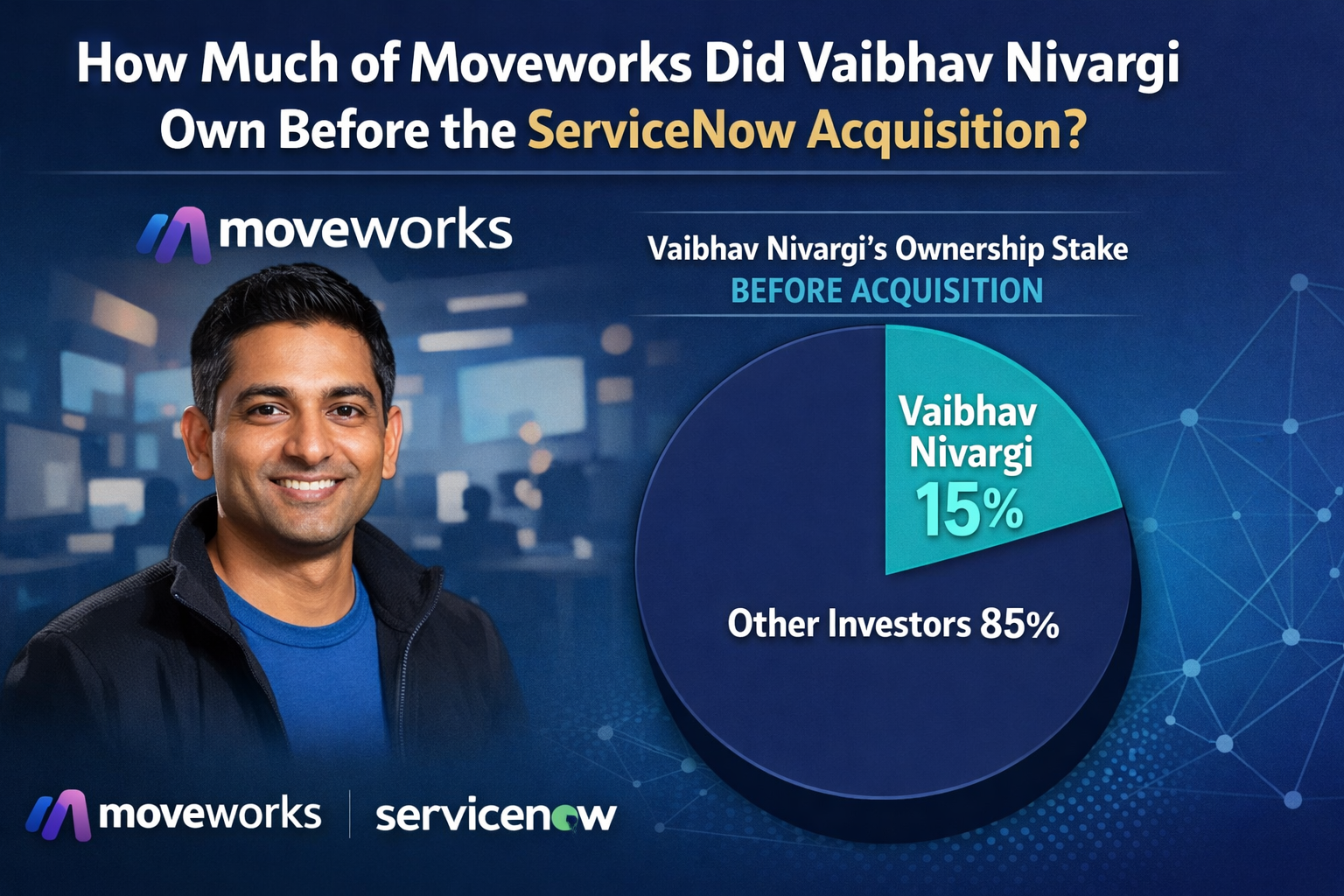
When people search for Vaibhav Nivargi Moveworks stake, they are usually looking for one clear answer: how much of Moveworks he actually owned before ServiceNow agreed to buy the company. The most reliable source for that is the merger filing submitted to the U.S. Securities and Exchange Commission. According to that filing, Vaibhav Nivargi beneficially owned 35,977,627 shares of Moveworks, equal to 13.89% of the company on an as-converted basis as of March 9, 2025.
That makes Nivargi one of the most important individual shareholders in the company’s founding story and its exit story. It also explains why his ownership became more interesting once TechCrunch reported on March 10, 2025 that ServiceNow had agreed to acquire Moveworks for $2.85 billion in a mix of cash and stock. Once a company reaches that kind of outcome, founder equity stops being a background detail and becomes part of the main story.
The short answer on Vaibhav Nivargi’s stake
The cleanest answer is simple. Before the ServiceNow acquisition, Vaibhav Nivargi owned 13.89% of Moveworks, representing 35,977,627 shares beneficially owned under the terms described in the SEC filing. The filing says the ownership table was based on 258,945,241 shares of common stock outstanding on March 9, 2025, assuming conversion of the company’s preferred stock and Class F Stock into common stock. It also explains that beneficial ownership includes voting or investment power and may include certain exercisable options and unvested restricted shares for percentage calculations.
That means the number is not just a casual estimate from a blog or secondary profile page. It comes from the same formal filing that lays out the merger, the ownership table, and the treatment of directors and executive officers. So if the question is how much of Moveworks he owned before the deal, 13.89% is the answer most people should use.
Who is Vaibhav Nivargi at Moveworks
The ownership story matters more because Nivargi was not a minor executive or late hire. Moveworks identifies him as CTO and co-founder, and the company says he oversees core infrastructure and platform functions. Its company page also notes that before Moveworks, he founded ClearStory Data and was one of the early engineers at Aster Data, and that he holds an MS in Computer Science from Stanford University.
That background helps explain why his stake was substantial. Founder ownership often reflects not just title, but how early and how deeply someone was involved in building the company. In Moveworks’ case, the official company page lists Bhavin Shah, Varun Singh, Jiang Chen, and Vaibhav Nivargi as the four founders, with Nivargi specifically holding the CTO and co-founder role.
How the filing breaks down his ownership
The most useful part of the SEC filing is that it does not stop at the headline number. It also explains where Nivargi’s beneficial ownership came from. The filing says his total consisted of 685,206 shares held directly by Mr. Nivargi, 26,542,421 shares held by the Nivargi Family Revocable Trust, 3,500,000 shares held by the Nivargi Family GST Trust, and three separate 1,750,000-share trust holdings connected to family estate-planning vehicles. The same note says the total included 2,435,206 restricted shares, of which some had already vested and some were still expected to be repurchased in connection with the transaction.
The filing also says Nivargi had previously exercised 2,435,206 options at an exercise price of $0.74 per share, under an Early Exercise Stock Option Agreement, and that he entered into a Secured Recourse Promissory Note and Pledge Agreement in connection with that exercise. That level of detail matters because it shows his ownership was not just a simple “founder owns stock” situation. It was structured through direct holdings, trust holdings, and previously exercised equity instruments, which is common in late-stage private-company cap tables but easy to miss if someone only looks at summary articles.
Why his stake drew attention after the deal
The stake became especially notable because of the size of the transaction. TechCrunch reported that ServiceNow would pay $2.85 billion for Moveworks in cash and stock, with the deal expected at that time to close in the second half of 2025. The merger filing similarly describes the transaction as a combination of cash consideration and ServiceNow common stock, subject to the deal’s election and exchange mechanics.
Once that acquisition was announced, public interest naturally shifted toward who owned what. A founder with nearly 14% beneficial ownership is not just a technical leader. He is one of the central financial stakeholders in the company. That is why Vaibhav Nivargi’s ownership percentage became a search topic in the first place. People were not only asking who he was. They were asking how important his equity position was inside a multibillion-dollar exit. That is a fair inference from the filing and the timing of search interest around the acquisition.
How his ownership compared with the founding circle
The filing also gives useful context by showing that Nivargi’s stake was almost identical to Bhavin Shah’s. The ownership table lists Bhavin Shah at 35,977,626 shares, or 13.89%, while Vaibhav Nivargi is listed at 35,977,627 shares, also 13.89%. By comparison, Varun Singh is shown at 13,938,573 shares, or 5.38%, and Jiang Chen appears below them in the same section.
That is an important detail because it shows Nivargi was not a secondary founder in ownership terms. He sat right at the top of the founder ownership structure, effectively tied with Shah based on the numbers shown in the table. For a company like Moveworks, where product depth and platform architecture were central to the business, that alignment between founding technical leadership and ownership is not surprising, but it is still notable. That last point is an inference based on his role and the cap table, rather than a direct quote from the filing.
Why the stake matters beyond the number itself
On paper, the percentage answers the main question. But the bigger reason it matters is what it says about Moveworks as a company. Moveworks built its reputation around enterprise AI, automation, and workplace support, and ServiceNow bought it to strengthen its own AI portfolio. TechCrunch framed the deal as part of ServiceNow’s push deeper into AI, while Moveworks’ own company pages continue to position the founders as central to building the platform.
So when you look at Vaibhav Nivargi’s ownership before the acquisition, you are really looking at more than a cap-table stat. You are looking at how strongly the company’s technical founding team remained tied to the business at the moment of exit. In many startup stories, that is one of the clearest signals of how the company was built and who helped create most of its long-term value. That is an inference, but it fits the relationship between his founder role, technical leadership, and ownership position.
The direct answer
If you want the straightforward answer for your article, this is it: before the ServiceNow acquisition, Vaibhav Nivargi beneficially owned 35,977,627 shares of Moveworks, representing 13.89% of the company, according to the SEC merger filing dated April 23, 2025, with ownership measured as of March 9, 2025. That made him one of the company’s biggest individual stakeholders and one of the most important founder-shareholders in the deal.
