



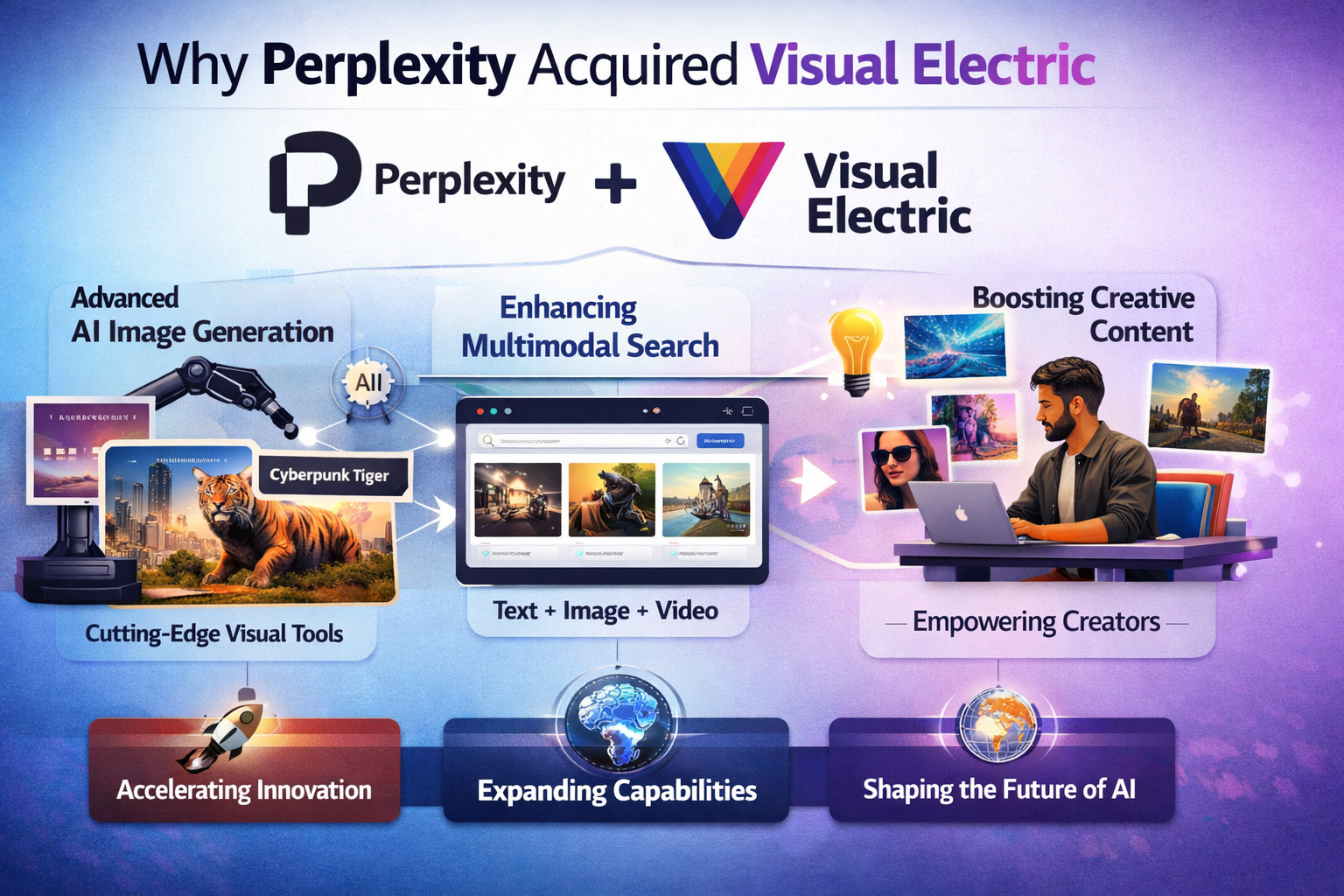
When Perplexity acquired Visual Electric in October 2025, it did not look like a simple add-on deal for another AI image tool. The reporting around the acquisition pointed to something more specific. Perplexity brought in the Visual Electric team to form a new Agent Experiences group, while the standalone Visual Electric product was set to sunset over 90 days. That alone tells you the company was buying more than a product. It was buying people, design instincts, and a different kind of AI interface expertise.
That is the clearest answer to the question. Perplexity acquired Visual Electric because it wanted stronger creative and visual product capabilities to help shape richer AI experiences across Perplexity itself and Comet, its browser product. The move fits a broader pattern in AI right now: the winning companies are not only chasing better models, they are also chasing better interfaces, better workflows, and better ways for people to actually use those models in everyday products.
Visual Electric brought more than an image generator
One reason the acquisition makes sense is that Visual Electric was not being described as a basic text-to-image startup. TechCrunch and Built In both described it as an AI design tool built for designers, with features like AI image generation, editing on an infinite canvas, and the ability to turn images into videos. That matters because it means Visual Electric was already working at the intersection of creative tooling, visual workflows, and product design, not just model output.
That kind of product DNA is valuable. A company can build or license models, but it is much harder to quickly build a team that understands how creative users want to work with AI visually. Visual Electric had already spent time solving those interaction problems. It had a designer-friendly experience, a visual workspace, and a product identity that felt closer to creative software than to a raw AI demo. That likely made it more attractive to Perplexity than a startup that only offered model access without a strong user experience layer. This is an inference from how the product was described across the coverage.
The key phrase is Agent Experiences
The most important clue in the entire deal is the phrase Agent Experiences. TechCrunch reported that the Visual Electric team would join a new Agent Experiences group at Perplexity, and Built In repeated the same point. That phrasing matters because it shifts the story away from a narrow design-tool acquisition and toward a bigger product ambition.
If Perplexity only wanted a visual generation feature, it could have quietly integrated one into the existing product stack. Instead, it brought in a whole team and gave that team a role tied to new agent experiences. That suggests Perplexity is thinking about how AI agents should look, feel, and behave from a user’s point of view, not just what answers they can generate. In practical terms, that could mean more visual interaction, more multimodal workflows, and more polished consumer-facing AI experiences over time. That is an inference, but it lines up closely with the way the acquisition was described.
This was also a move beyond search
Another reason the acquisition stands out is that it pushes Perplexity further beyond its original identity as an AI answer engine. TechCrunch reported that the Visual Electric team would work on “new consumer product experiences” on both Perplexity and Comet. That detail is easy to miss, but it is one of the most important in the whole story. It shows the company is expanding its ambitions beyond search and retrieval into broader product experiences.
That matters because AI competition is getting more crowded. It is no longer enough to return an answer with citations. Companies want to become the place where users research, create, iterate, and act. Bringing in a team like Visual Electric gives Perplexity a better chance to build experiences that feel more dynamic and visually native, especially if it wants Comet to become more than just another browser with AI layered on top. Again, that is an inference from the reporting, but it is a grounded one.
The shutdown tells you this was an integration play
The fate of the standalone Visual Electric product also says a lot. TechCrunch, Investing.com, and other reports said the service would sunset over 90 days, that users would be able to export their data, and that annual subscribers would receive prorated refunds. That is not the language of a company trying to run two separate brands side by side. It is the language of integration.
That is why the acquisition feels strategic rather than opportunistic. Perplexity was not buying Visual Electric to keep it alive as a standalone design business. It was absorbing the team and the capabilities into its own roadmap. From a product strategy perspective, that usually means the buyer sees more value in embedding the talent and technology internally than in maintaining a separate service. It is a fairly common pattern in startup acquisitions, but here it is especially clear because the shutdown plan was communicated right away.
The Sequoia angle added credibility, but it was not the main reason
Coverage also highlighted that Visual Electric was Sequoia-backed. Built In said the startup had raised $2.5 million from investors including Sequoia Capital, while TechCrunch repeatedly referred to it as a Sequoia-backed AI design startup. That background helped signal that Visual Electric was not a random side project. It had investor backing, product ambition, and enough credibility to matter in the market.
Still, the acquisition does not look like it happened because of cap table prestige alone. The stronger explanation is product fit. Visual Electric had a team that understood creative AI interfaces, and Perplexity had a need to build better AI experiences for consumers. The investment pedigree made the company easier to take seriously, but the reported structure of the deal points much more strongly to talent and roadmap value than to brand-name investors. This is an interpretation based on the way the transaction was covered.
The competitive backdrop matters, but it is not the whole story
Some outlets pushed a more dramatic angle. Economic Times framed the deal as part of Perplexity’s effort to compete more directly with OpenAI’s Sora and Google’s Nano Banana in visual AI. That backdrop is useful because it shows where the market is heading, but it is probably not the most precise way to understand the acquisition.
The more grounded reporting from TechCrunch and Built In kept the focus on the internal product reason for the deal: new Agent Experiences, stronger consumer experiences, and a creative AI team joining Perplexity. So yes, the broader visual-AI race matters. But the cleaner explanation is that Perplexity wanted to improve what its own products can become, not just chase headlines about competing with every other AI company at once.
Why the deal makes sense
Put together, the logic is pretty straightforward. Perplexity acquired Visual Electric because Visual Electric had the exact kind of team and product sensibility that could help transform AI from a text-heavy experience into something more visual, more interactive, and more polished. The startup brought expertise in AI design, image generation, video generation, and infinite-canvas creative workflows. Perplexity brought distribution, brand momentum, and a bigger platform where those ideas could go further.
That is what makes this acquisition interesting. It is not just about adding a feature. It is about shaping what AI products feel like when they move beyond chat boxes and search results. Perplexity seems to understand that the next big leap in AI will not come only from smarter models. It will also come from better experiences around those models. And that is exactly why Visual Electric was worth acquiring.
