



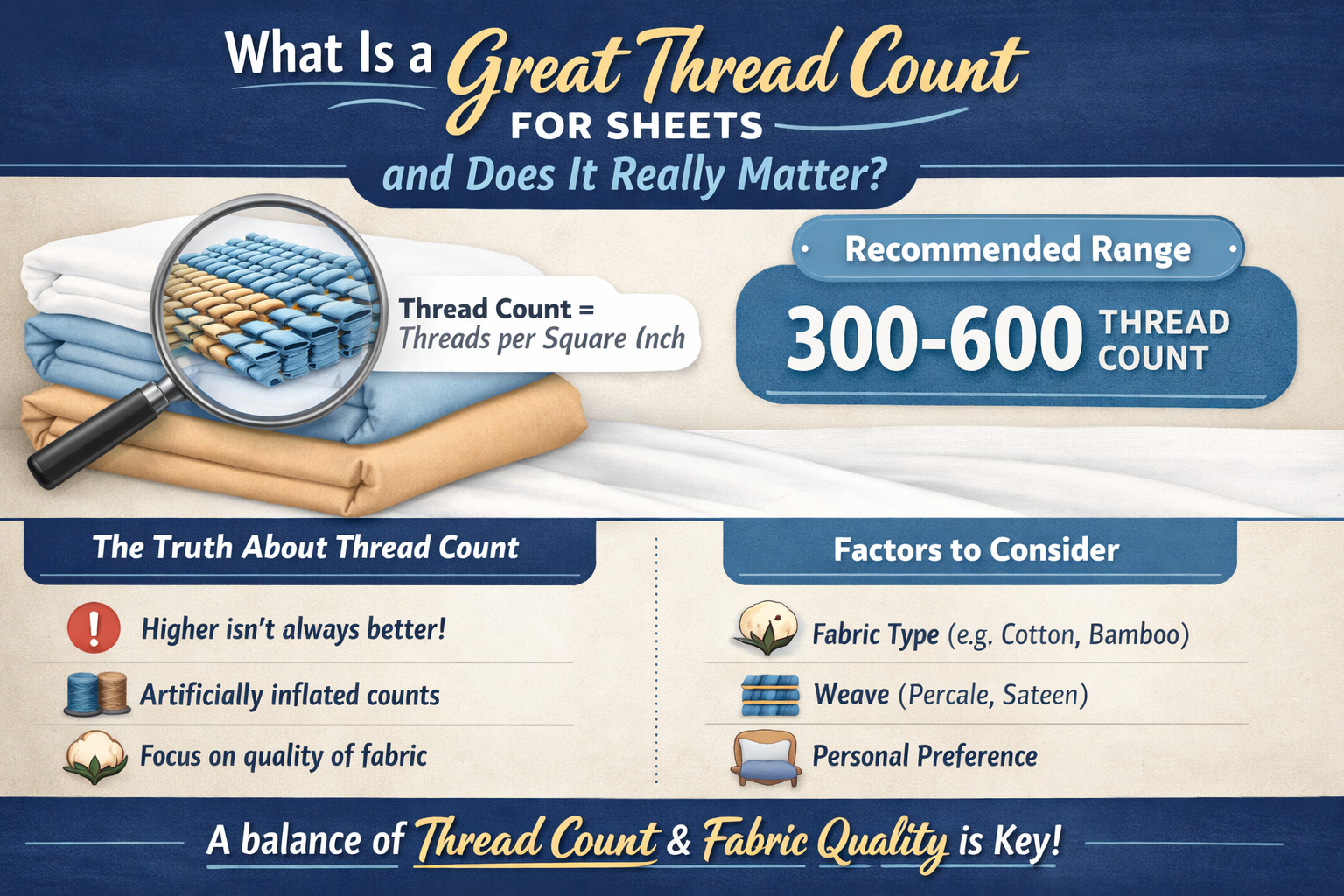
If you have ever shopped for bed sheets, you have probably seen thread count treated like the ultimate sign of quality. Higher number, better sheet. That is the sales pitch. But the real answer is a lot less dramatic and a lot more useful. For 100% cotton sheets, a great thread count is often somewhere in the 300 to 500 range, and even that number only matters when the fiber quality and weave are good to begin with. Good Housekeeping says sheets in that range tend to perform best in testing, while anything much higher is not automatically better and can even be misleading.
So yes, thread count matters. But no, it is not the whole story. If you focus on the number alone, you can easily end up paying more for sheets that are heavier, less breathable, or simply marketed better.
What thread count actually means
At its most basic, thread count is the number of threads woven into one square inch of fabric. That sounds simple enough, but the number can be presented in ways that make it seem more meaningful than it really is. Some manufacturers use multi-ply yarns, which can push the count higher on paper without necessarily making the fabric softer, stronger, or more comfortable. That is one reason bedding experts keep warning shoppers not to chase the biggest number they can find.
This is also why the phrase “high thread count” can be a little slippery. A 1,000-thread-count label sounds luxurious, but Good Housekeeping says shoppers should be skeptical of counts substantially over 1,000, and its testing found that the best-performing 100% cotton sheets were generally in the 300 to 500 range instead.
So what is a great thread count for sheets?
If you want one short, practical answer, here it is. For 100% cotton sheets, a great thread count is usually 300 to 500. That range tends to offer the best balance of softness, breathability, and durability. It is high enough to feel smooth and substantial, but not so high that the fabric becomes overly dense or stuffy.
That said, you do not need to panic if you see a set below 300. Good Housekeeping explicitly notes that you can still find quality sheets under 300, and Leesa says buyers who prefer more texture or want a more budget-friendly option can still find excellent 200 to 300 thread count sheets.
So the better question is not “What is the highest number I can buy?” It is “What kind of feel do I want, and is the fabric itself good?”
Why higher is not always better
This is where a lot of sheet buying goes sideways. People assume a bigger number must mean a better night’s sleep. But higher thread count often comes with trade-offs. Good Housekeeping recently tested 100% cotton sateen sheets ranging from 200 to 1,000 thread count and found that the 400-thread-count option delivered the best overall balance of softness and durability. The 1,000-thread-count sheet was stronger, but it did not stand out in softness and performed worse in pilling resistance.
That lines up with what a lot of experienced shoppers already suspect. Once the number gets pushed too high, the sheet can start to feel heavier and less breathable. If you sleep warm, that can be the opposite of what you want. Leesa also points out that moderate-thread-count sheets made from better fibers can offer a better balance of comfort and airflow than flashy high-count options.
In other words, there is a point where more stops being better and starts being marketing.
Percale and sateen change the conversation
One reason the “best thread count” question is tricky is that weave changes how sheets feel. A percale sheet and a sateen sheet can both be made from cotton, but they do not feel anything alike. Good Housekeeping says percale is lightweight, airy, and crisp, while sateen feels silky smooth and more substantial.
That matters because a great thread count for percale may not be the same as a great thread count for sateen in real life. A crisp, breathable percale often feels excellent at a lower count, while sateen usually feels smoother and slightly heavier, so it can land a bit higher without feeling wrong. You can see that in real market examples too. Brooklinen’s Classic Percale is listed at 270 thread count, while its Luxe Sateen comes in at 480, and each is aimed at a different sleep style.
So if you love that hotel-style crispness, a lower-count percale can be exactly right. If you want a softer, silkier finish, sateen may suit you better, even with a somewhat higher number. The point is that the feel comes from the combination of weave, fiber, and construction, not just the count.
What matters more than thread count
This is the part shoppers really need. Once you get into a reasonable range, fiber quality matters more than the number on the package. Good Housekeeping says thread count is really most relevant for 100% cotton sheets, which means other materials should be judged differently. Its bedding shopping guide also warns shoppers about inflated counts and misleading marketing, especially when labels try to use the number as a shortcut for quality.
If you want better sheets, pay attention to things like long-staple cotton, single-ply yarns, and the overall feel of the fabric. Those details tend to tell you more about how the sheet will sleep and how it will hold up after washing. Even Leesa frames the decision this way, noting that the best choice depends on personal preference, budget, and how you want the sheets to feel, not just the count printed on the label.
And once you leave 100% cotton, the number becomes even less helpful. Linen, for example, often has a much lower count and may not even list one prominently, yet it can still be excellent bedding. Leesa notes that a good range for linen is around 80 to 140, and that thread count is simply less important for that fabric.
How to choose the right sheets for your sleep style
If you are a hot sleeper, breathable cotton percale is usually a better direction than chasing a super-high thread count. Crisp, airy construction tends to matter more than a dense fabric when you want to stay cool. Good Housekeeping describes percale as more breathable and less smooth than sateen, which is exactly why so many hot sleepers prefer it.
If you want a softer, smoother, more polished feel, sateen may be a better fit. In that case, a somewhat higher thread count can make sense, but you still do not need to chase an absurd number. The recent Good Housekeeping testing suggests that around 400 can already be a sweet spot for performance and comfort.
If budget matters most, do not assume lower is bad. Plenty of good sheets live in the 200 to 300 range, especially if the fabric is well made. And if you want a general safe zone for 100% cotton, the 300 to 500 range is still the most practical place to look.
The answer most people actually need
So, does thread count really matter? Yes, but only when you keep it in perspective. A great thread count for sheets is not the biggest one you can afford. It is the one that fits the fabric, the weave, and the way you sleep. For most people buying 100% cotton sheets, that means aiming somewhere around 300 to 500, staying open to lower counts for percale, and remembering that fiber quality matters more than marketing hype.If you remember one thing, make it this: the best sheets are not defined by one number. They are defined by how they feel at bedtime, how they breathe through the night, and how well they hold up after months of washing. That is a much better way to buy bedding than chasing the loudest thread count on the shelf.
