



A strong business description can quietly do a lot of work for your local presence. It helps people understand what you offer, what makes your business different, and whether they should trust you enough to call, visit, or book.
That is why editing matters.
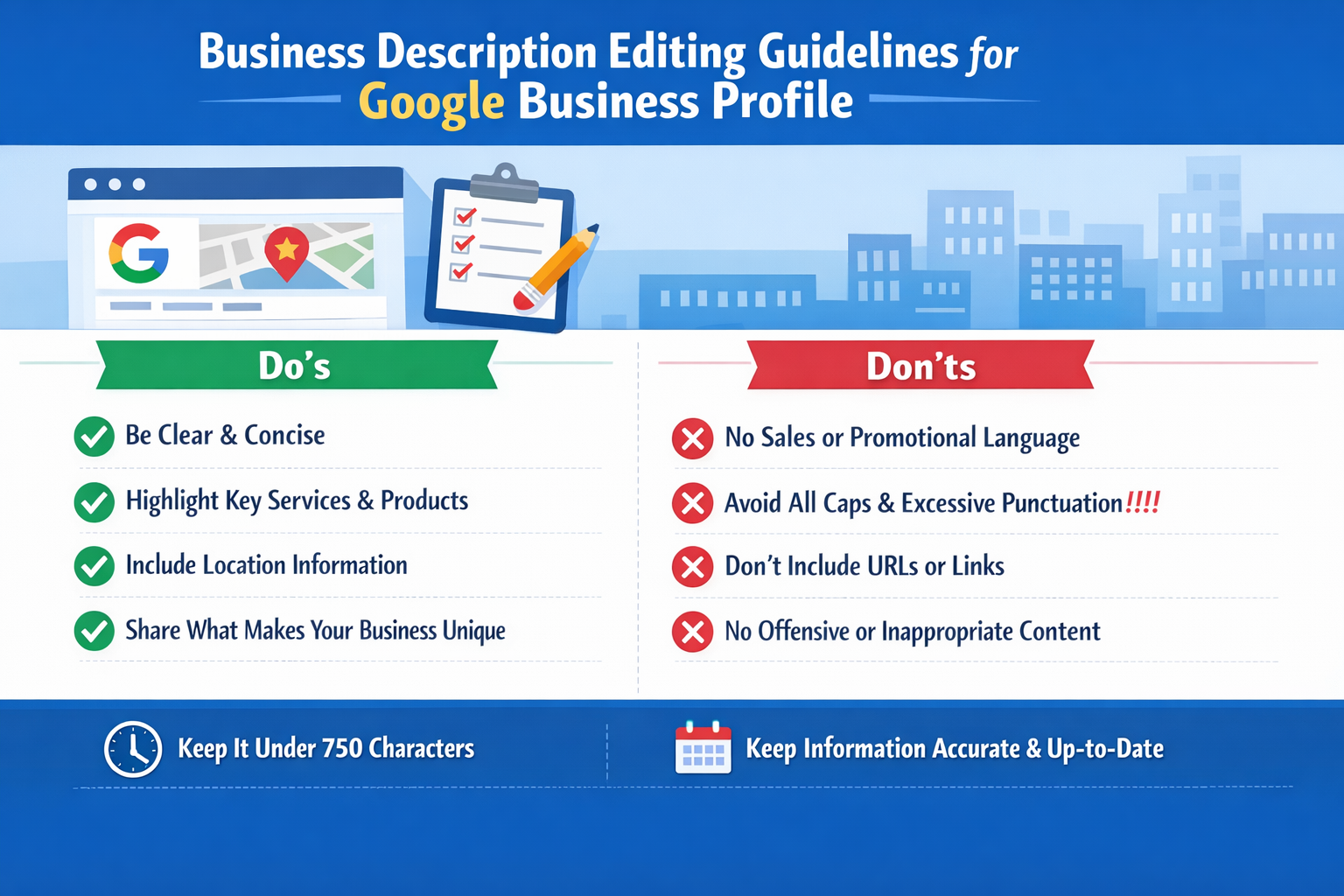
A rough, keyword-heavy description can make even a great business sound careless. A clear, well-edited one feels more professional and gives customers a better sense of who you are. When you are working inside Google Business Profile, that matters even more because Google has specific content rules for what belongs in the description field and what does not. Google says your business description should tell customers about your products or services, what sets you apart, your history, or other useful details, and it should stay within 750 characters. It also says to avoid URLs, HTML, and content that feels low quality, promotional, or irrelevant.
What the business description is actually for
The business description in Google Business Profile is not supposed to be a sales ad. It is there to help people quickly understand your business. According to Google, this is the place to explain what you offer, what makes your business unique, how long you have been serving customers, or any other practical information that helps someone decide if you are the right fit.
That means the goal is not to cram in as many keywords as possible.
The goal is to write something useful, readable, and accurate.
Think of it as a short introduction that should answer a few basic questions:
What does this business do?
Who does it serve?
What makes it worth considering?
What details help a customer feel confident?
If your description cannot answer those clearly, it needs editing.
Start with Google’s actual rules
Before you edit for style, you need to edit for compliance. Google has rules for business descriptions, and ignoring them can leave you with a weak listing or edits that do not add value.
Here are the essentials:
Your description can be up to 750 characters.
It should focus on your business, not random marketing claims.
It should not include URLs, HTML code, or other formatting tricks.
It should avoid irrelevant content, low-quality filler, excessive promotion, or gimmicky text.
So if your current description says something like this:
“Best dentist in town!!! Visit our website now for special offers and discounts at www.example.com”
that is already heading in the wrong direction.
A better version would describe the actual service, location context, customer focus, and differentiators in a clean, natural way.
Write for people first, then polish for local SEO
A lot of businesses make the same mistake. They hear “local SEO” and immediately turn the description into a pile of repeated phrases.
That usually backfires.
A better approach is to write naturally, then lightly optimize. Advice Local recommends using relevant keywords thoughtfully, keeping your brand tone consistent, including meaningful location details where appropriate, and avoiding keyword stuffing.
So instead of this:
“Plumber in Austin, Austin plumber, plumbing service Austin, emergency plumber Austin”
try something like this:
“We provide residential and commercial plumbing services in Austin, including leak repair, drain cleaning, water heater service, and emergency plumbing support.”
The second version still includes relevant terms, but it sounds like a real business speaking to real customers.
The best structure for editing a business description
When you are revising a description, it helps to follow a simple structure. That keeps the writing clear and stops the field from turning into a messy summary.
A practical order looks like this:
1. Start with what the business does
Lead with the core service or product.
People should not have to guess what kind of business you are.
Example:
“Bright Smile Dental is a family dental practice in Chicago offering preventive care, cosmetic dentistry, and restorative treatments for children, teens, and adults.”
That opening is direct, readable, and informative.
2. Add what makes the business different
This is where you mention your edge, but without sounding exaggerated.
You can refer to:
- years in business
- specialized experience
- customer approach
- product quality
- service style
- niche expertise
Example:
“We focus on gentle, patient-centered care and same-week appointments for urgent dental needs.”
That is much stronger than saying “best service in the city.”
3. Include useful local context if it fits
If location matters, mention the neighborhood, city, or service area naturally.
Example:
“We serve homeowners and small businesses across Austin, including Downtown, South Congress, and surrounding communities.”
This supports local relevance without turning the text into a keyword list.
4. End with credibility or service breadth
Use the last part of the description to reinforce trust or scope.
Example:
“Our team works on everything from routine maintenance to full system installations, with a focus on clear communication and reliable service.”
That leaves the reader with something concrete.
What to remove when editing
Sometimes good editing is less about adding and more about cutting.
Here is what usually weakens a Google Business Profile description:
Repetitive keywords
If the same phrase appears again and again, cut it down. You are not helping search visibility by making the text awkward.
Empty marketing language
Phrases like “world-class service,” “industry-leading excellence,” or “the number one solution” often add nothing. If a sentence could apply to almost any business, it is probably too vague.
Promotional offers and sales copy
The description is not the place for discount language, sales hype, or aggressive calls to action. Google specifically limits overly promotional and irrelevant content.
Links and formatting tricks
No URLs. No HTML. No weird symbols to grab attention. Google’s guidance is clear on that.
Generic filler
Cut lines like:
“We are committed to customer satisfaction”
“We value quality and excellence”
“We are here to serve all your needs”
These are not harmful on their own, but they waste space if they are not backed by something specific.
Editing guidelines that actually improve readability
Beyond policy, the strongest competitors around editing all point to the same writing basics: clarity, precision, consistency, and flow. Broader business-writing sources emphasize removing awkward wording, vague phrasing, grammar issues, and anything that makes the message harder to understand.
Here are the editing habits that make the biggest difference:
Keep sentences short and clean
Long sentences eat up your character count and make the description feel bloated.
Instead of:
“We are a dedicated and passionate team that has been proudly serving the wider community with a range of high-quality and affordable professional services for many years.”
try:
“We provide affordable home cleaning services for families and property managers across Phoenix.”
Cleaner. Stronger. Easier to read.
Use specific words
Specific words build trust.
Weak:
“We offer many solutions for different needs.”
Better:
“We offer bookkeeping, payroll support, tax preparation, and monthly financial reporting for small businesses.”
Make the tone sound human
A business description should feel professional, but it should still sound like a real person wrote it.
That means avoiding stiff corporate phrases and overblown claims.
Natural copy feels more believable.
Watch grammar and consistency
Check your spelling, punctuation, capitalization, and sentence flow. If your brand name, service terms, or location names are styled inconsistently, the listing can look sloppy. Style guides and editing resources consistently highlight grammar, punctuation, capitalization, and formatting as part of polished business writing.
A simple editing checklist for Google Business Profile
Before you publish, run your description through this checklist:
Does it clearly explain what the business does?
Does it mention real products, services, or specialties?
Does it sound natural when read out loud?
Does it include local context where relevant?
Does it avoid keyword stuffing?
Does it stay under 750 characters?
Does it avoid URLs, HTML, prices, and promo-heavy wording?
Does it highlight something genuinely useful or distinctive about the business?
If the answer is yes across the board, you are in good shape.
Example of weak vs edited copy
Here is a simple before-and-after example.
Weak version
“Elite Home Repair is the best home repair company in Dallas. We offer top quality service, affordable prices, and amazing customer support. Visit our website now for offers. We do plumbing, roofing, painting, remodeling, home repair Dallas, handyman Dallas, Dallas contractor.”
Edited version
“Elite Home Repair provides home repair and handyman services in Dallas, including plumbing, painting, roofing, and small remodeling projects. We work with homeowners who want dependable service, clear communication, and practical solutions for everyday repair needs.”
Why the second one works better:
It tells you what the business does.
It includes the location naturally.
It removes hype.
It avoids stuffing.
It sounds more trustworthy.
How often should you revise your description?
You do not need to rewrite it every month just to stay active.
But you should revisit it when:
- your service mix changes
- you expand into new areas
- you narrow your niche
- your brand positioning becomes clearer
- your current description feels outdated or generic
A business description should reflect the business as it exists now, not the version from three years ago.
The real goal of editing
At the end of the day, good editing is not about making the description sound fancy.
It is about making it clear.
A strong Google Business Profile description tells people what you do, helps them understand your value quickly, and stays within Google’s content rules. That is where strong local visibility and strong first impressions start. Google expects business information to be accurate, useful, and not overloaded with distracting or irrelevant content, and the best local listing advice echoes that same idea.
If your current description feels cluttered, generic, or overly optimized, the best move is usually simple: cut the fluff, keep the useful details, and write like a business that actually knows its customers.
