



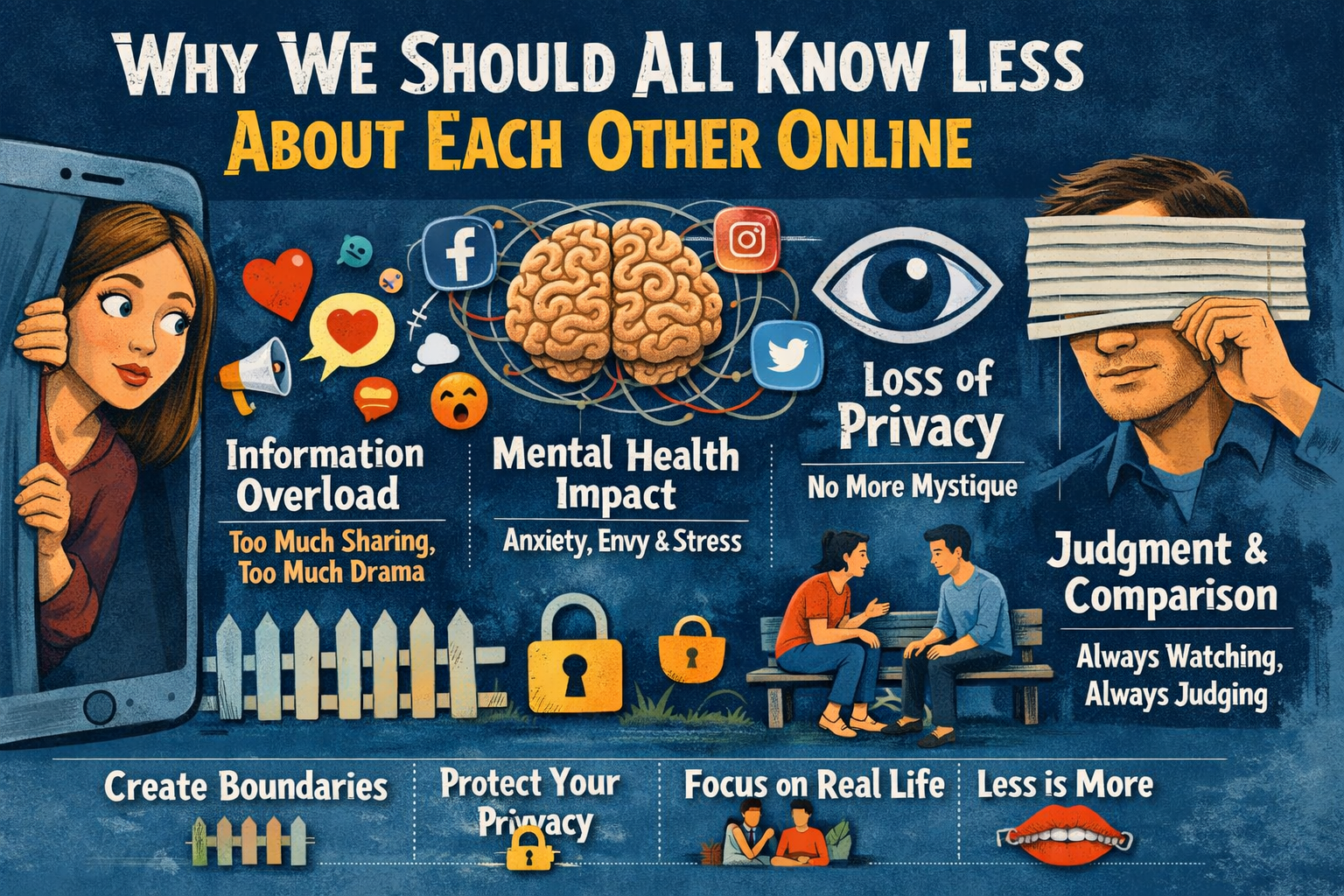
The phrase “we should all know less about each other” landed because it put words to a feeling a lot of people already had but had not fully named. It first took off after a 2021 New York Times Opinion piece by Michelle Goldberg, and it stuck because it captured something deeper than ordinary internet annoyance. It was not just about people posting too much. It was about how social media keeps pushing private life into public view, then acting as if more exposure automatically means more connection.
That idea feels even more relevant now. Recent commentary in Psychology Today used the same phrase to criticize Instagram’s “With Friends” feature, arguing that platforms are turning digital behavior into a kind of involuntary self-revelation. In other words, the problem is no longer only what we choose to share. It is also what platforms infer, surface, and package for other people to see.
Too much access is not the same thing as closeness
For years, the internet sold us a simple story. More sharing would make us more connected. More visibility would make us more understood. More access would make relationships feel more real. But online life has a way of confusing access with intimacy.
Knowing what someone liked at 1:12 a.m., what they bookmarked, who they followed, what they watched, what they posted after a breakup, or what they seem to believe this week does not necessarily bring you closer to them. A lot of the time, it just gives you more fragments. And fragments are dangerous because the brain is very good at turning fragments into certainty.
That is part of why so much online life feels tense. We are constantly building stories about each other from bits of evidence that were never meant to carry that much weight. A comment becomes a personality. A follow becomes a worldview. A post becomes a moral profile. A joke becomes a permanent file. What should have stayed small becomes social evidence.
Social media was built to make private life legible
One reason this feels so exhausting is that the system is doing exactly what it was designed to do. Platforms do not simply host expression. They organize it, rank it, amplify it, and translate it into signals. The recent Psychology Today piece makes this point clearly by arguing that newer platform features reshape trust and privacy by making people more legible to one another than they intended to be.
That kind of visibility changes behavior. Once people know they are always potentially being observed, interpreted, and archived, they stop communicating naturally. They start managing impressions. They post with future audiences in mind. They shape themselves around what will read well, travel well, or cause the least friction. The result is a strange mix of oversharing and performance. People reveal more, but often in a way that feels less human.
So yes, we may technically know more about each other online. But often we know more in the shallowest possible way.
Oversharing has become a cultural expectation
The phrase also resonates because it pushes back against a newer kind of pressure, the idea that being honest means being fully exposed. In a lot of online spaces, privacy is treated almost like dishonesty. If you are not constantly sharing, explaining, posting, confessing, clarifying, and updating, people assume you are hiding something or lacking authenticity.
That is a terrible standard.
Not every feeling needs an audience. Not every struggle needs content. Not every relationship needs visibility. Not every belief needs a thread. And not every private moment becomes better by being made public. Commentary in RELEVANT and other culture pieces has echoed this same point by arguing that some things are simply not meant to be shared publicly.
There is a difference between openness and overexposure. One can build trust. The other can flatten a person into a stream of disclosures.
Knowing too much can make us harsher
There is another reason we should all know less about each other online. Too much exposure does not just blur boundaries. It can also make people more judgmental.
When you are given a nonstop feed of other people’s opinions, habits, quirks, bad days, contradictions, jokes, likes, aesthetics, weak moments, and half-formed thoughts, you are going to dislike more of them. That is not because everyone suddenly became worse. It is because constant visibility gives us more chances to be irritated, suspicious, or morally offended.
The original New York Times framing, as reflected in public references and later commentary, tied this dynamic to broader problems like Facebook, polarization, and the false assumption that more online exposure is inherently good. The critique was not simply about cringe. It was about the way digital environments can intensify resentment and social hostility.
That matters. In ordinary life, healthy distance often protects relationships. You do not need a full transcript of everyone’s impulses to live alongside them. A little mystery makes room for patience. A little privacy makes room for grace.
The workplace version is real too
This problem is not limited to friends and followers. It shows up at work as well. The phrase has been picked up in workplace commentary too, which makes sense. When professional life and personal visibility collapse into each other, it becomes harder to preserve boundaries that used to be normal.
Coworkers do not need to know everything about your emotional life, your political drift, your late-night posting habits, your family tension, or your personal timeline. And you probably do not need that level of access to theirs either. Professional relationships often work better when there is some respectful distance.
That does not mean being cold or fake. It means recognizing that boundaries are not a failure of connection. They are often what makes connection sustainable.
Privacy is not selfish
One of the biggest mistakes of internet culture was teaching people to see privacy as withholding. But privacy is not meanness. It is not secrecy in the sinister sense. It is not emotional dishonesty. Very often, it is just good stewardship of the self.
You are allowed to have an inner life that is not optimized for spectators. You are allowed to keep parts of yourself unposted, unfinished, and unmonetized. You are allowed to let some experiences stay intimate, local, and unsearchable.
That is part of what makes the phrase so powerful. “We should all know less about each other” sounds harsh at first, but underneath it is a defense of ordinary human boundaries. It suggests that some social peace comes not from radical transparency, but from selective opacity.
There is wisdom in not being fully available to everyone all the time.
What healthier online life could look like
If we take the phrase seriously, it does not require disappearing from the internet. It just asks for a different posture.
It might mean sharing later instead of instantly. It might mean posting less during emotionally charged moments. It might mean resisting the urge to interpret every digital trace as deep truth. It might mean not turning every preference into identity and every identity into content. It might mean letting friendships happen in smaller spaces instead of public feeds.
It might also mean expecting less access to other people. That part gets overlooked. We often talk as if oversharing is mainly a problem of people who reveal too much. But there is also an audience problem. Many of us have grown too comfortable consuming the details of people’s lives as ambient background. We have started to expect transparency from others that we would once have considered invasive.
A healthier culture would ask both sides to change. Share less impulsively. Expect less entitlement.
Why the phrase keeps sticking
The reason this phrase keeps resurfacing is simple. It explains a modern discomfort with unusual precision. People are tired of living in systems where everything becomes signal, everyone becomes content, and privacy starts to feel old-fashioned.
The phrase does not argue against closeness. It argues against forced legibility. It does not say relationships should be shallow. It says they should not be built on nonstop exposure, algorithmic inference, and the collapse of every boundary into the public feed.That is why Michelle Goldberg’s original formulation still travels, why newer essays about Instagram revived it, and why it now functions as shorthand for a much broader cultural exhaustion with oversharing and hyper-visibility.
