



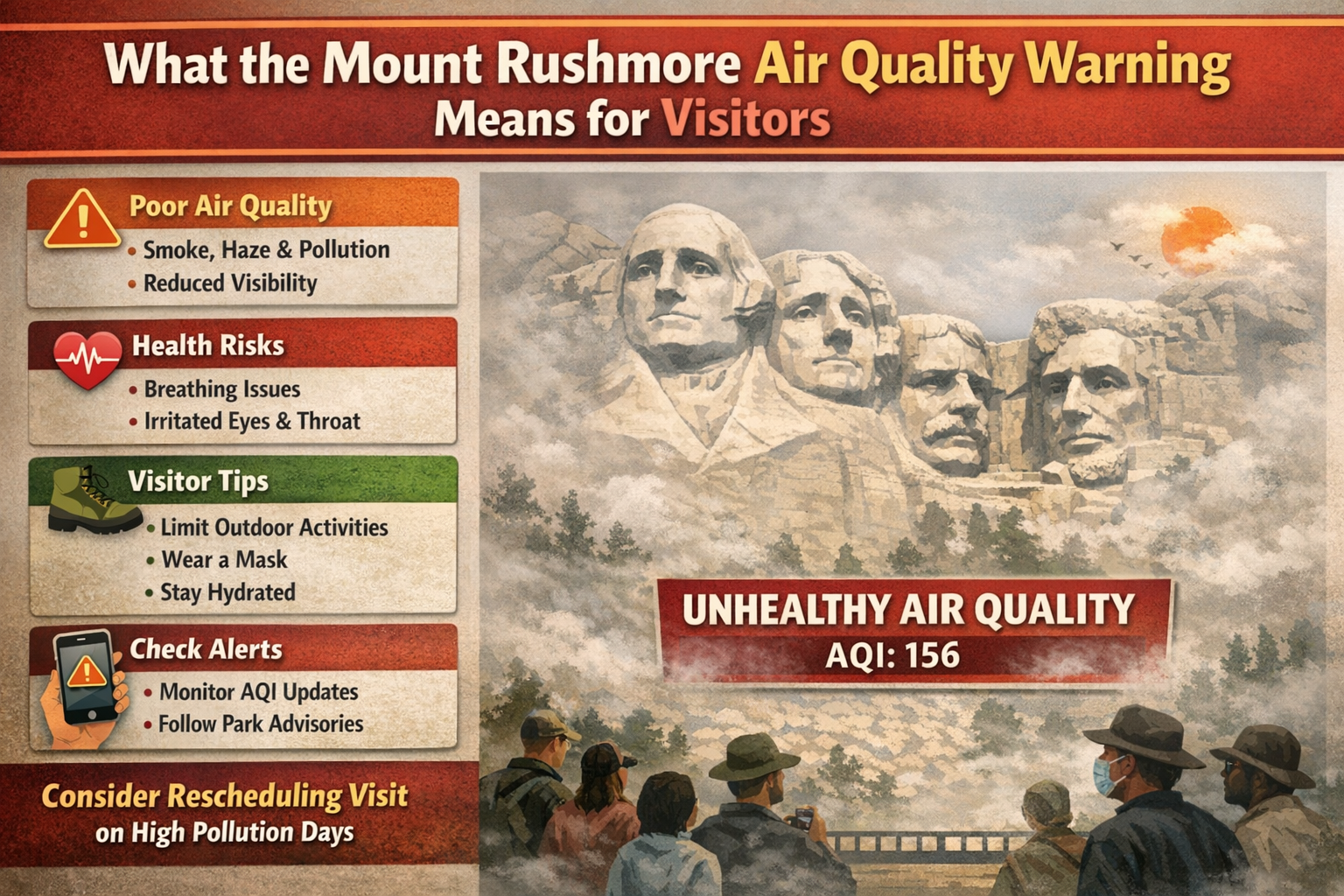
The phrase Mount Rushmore air quality warning refers to the April 14 to 15, 2025 reporting cycle, when outlets such as Newsweek and The Independent covered unhealthy air in parts of western South Dakota and nearby Nebraska that many travelers pass through on the way to Mount Rushmore. The worst-affected zone was tied to AQI readings in the 151 to 200 range, which the Environmental Protection Agency classifies as Unhealthy. Newsweek also cited an IQAir reading of 161 around Badlands National Park, a major nearby stop for tourists.
What that means in plain English is simple. This was not just a technical air-quality update for scientists or weather watchers. It was a warning that outdoor conditions in the broader visitor corridor around Mount Rushmore could pose health risks, especially for children, older adults, and people with asthma or other lung conditions. For travelers, that changes how you plan your day, how long you stay outside, and whether a stop that looks fine on the map is actually comfortable in real life.
What actually happened around Mount Rushmore
One thing that matters here is geography. The reporting did not say the carving itself was sitting under the single worst reading at all times. Instead, the warning covered a wider regional area that included places like Badlands National Park, Lacreek National Wildlife Refuge, and the travel zone around Rapid City, which is a common base for people visiting Mount Rushmore. That is important because many visitors treat the monument, the Badlands, and nearby scenic stops as part of one trip, so regional air conditions can affect the whole experience, not just one exact point on the map.
It also shows how quickly these conditions can change. The 2025 warning was tied to that specific event window, not to permanent conditions at Mount Rushmore. In fact, AccuWeather currently shows Mount Rushmore Ut, SD at AQI 47, labeled Fair, for April 16, 2026. That is a useful reminder that air-quality alerts are highly dynamic. A place can look fine one day and become a problem the next, which is exactly why visitors should check live conditions before heading out.
What AQI really means for visitors
The Air Quality Index, or AQI, is the EPA’s tool for explaining how clean or polluted outdoor air is and what that means for your health. On the official AirNow scale, 0 to 50 is Good, 51 to 100 is Moderate, 101 to 150 is Unhealthy for Sensitive Groups, and 151 to 200 is Unhealthy. Once readings move above 100, air quality is no longer just a background issue. It starts becoming a health concern, first for more vulnerable groups and then, as numbers climb, for everyone.
That distinction matters for travelers because a warning is not just about whether the sky looks hazy. It is about what your body may experience while sightseeing. According to AirNow, ground-level ozone and airborne particles are the two pollutants that pose the greatest threat to human health. When the air gets worse, symptoms can range from irritation and coughing to breathing difficulty, and the risk is higher if you are already dealing with asthma, heart disease, or other respiratory issues.
What it means for a day at the monument
For most people, a visit to Mount Rushmore National Memorial is not just stepping out of a car for two minutes. It often includes walking, climbing stairs, standing at overlooks, moving between stops, and spending long stretches outdoors. When air quality reaches the Unhealthy category, AirNow says some members of the general public may begin to experience health effects, while sensitive groups may face more serious ones. In practical terms, that means a visit can feel more tiring, less comfortable, and potentially risky if you plan to stay outside for extended periods.
Even below that red zone, caution still matters. AccuWeather’s guidance says that when pollution rises into its higher categories, people may feel throat irritation or difficulty breathing, and outdoor activity may need to be limited or rescheduled. So even if conditions do not look dramatic enough to cancel an entire trip, they may still be strong enough to justify shortening a stop, avoiding strenuous activity, or shifting your most outdoor-heavy plans to another part of the day.
Who should be most careful
The 2025 warning mattered most for travelers in sensitive groups. Newsweek, citing EPA classifications, pointed specifically to children, older adults, and people with lung disease as groups more likely to be affected. AirNow adds broader context by noting that pollution exposure can be especially concerning for people with asthma and heart disease. If someone in your group already struggles with breathing issues, poor air quality is not a small inconvenience. It is a real health consideration that should shape your schedule.
Families should also think practically. A child who is normally fine on a short walk may have a harder time with extended outdoor exposure on a bad-air day, and older travelers may feel symptoms faster than expected. That does not automatically mean you have to scrap the entire trip, but it does mean you should take the warning seriously instead of treating it like a minor weather footnote.
How visitors should handle an air-quality warning
The best response is not panic. It is flexibility. Check AirNow or another live tracker the morning of your visit, especially if your plans include Mount Rushmore, Rapid City, and nearby parks in the same day. Since the April 2025 warning affected the broader region, not just one exact tourist stop, it makes sense to think in terms of the whole travel area rather than a single pin on a map.
If readings move into Unhealthy for Sensitive Groups or Unhealthy, shorten long outdoor stretches, avoid heavy exertion, and keep an eye on anyone in your group who starts feeling unwell. That kind of adjustment is exactly what these alerts are for. They are not there to ruin a trip. They are there to help visitors make smarter choices before irritation, breathing trouble, or fatigue turn a scenic stop into an avoidable problem.
Why this warning matters beyond one headline
The bigger lesson is that iconic destinations are not immune to regional air events. A place like Mount Rushmore may be famous for its views, but those views and the visitor experience around them are still shaped by larger environmental conditions across South Dakota and the Great Plains. The April 2025 coverage showed that even world-famous landmarks can be affected by air-quality issues tied to a wider surrounding area.
That is why this story resonates with travelers. It turns an abstract health metric into something practical. You may have hotel reservations, a scenic route planned, and perfect-looking photos in mind, but if the air is bad, the smartest move is to adapt. For visitors, that is what the Mount Rushmore air quality warning really means: not automatic danger at every moment, but a clear signal to check live conditions, protect sensitive travelers, and treat outdoor plans as flexible when the air stops cooperating.
